Protect Your Money And Your Property, The Big One Is Coming
Protect Your Money And Your Property, The Big One Is Coming
Time to prepare for a major period of economic pain.
Photo by Petrovich9
There’s no mincing words on this one — unless you’re rich, you’re in trouble. Inflation is raging and hitting everything from global food prices to the cost of a Netflix subscription. Oil briefly hit $120 a barrel, and frankly, there’s not a whole lot that U.S. producers can do about it. In Washington, no one seems to agree as to why the world is experiencing such drastic price increases, but the arguments definitely do seem to be drawn along political lines.
Some politicians in America are arguing that soaring inflation was caused by pandemic-induced imbalances in supply chains, while others argue that it was stimulus checks that caused prices to sky-rocket.
I’ll let you figure out which side is claiming which argument.
Regardless of whether you lean blue, red, or if you’re just utterly exhausted with the tug-of-war between conservative and so-called liberal politicians in the western world, you should know that neither of those reasons are correct.
The GOP argument that stimulus checks (whoops, gave away the answer) caused global inflation, is just stupid. Global inflation is, well, global, and while many Americans like to believe that every diaper they change and hamburger they eat affects the world economy — it doesn’t.
On the other hand, if you’re on the true blue left, and you believe that this was caused by Covid-19, well you’re also wrong.
So what is it then?
Many experts agree that in Europe, energy has been the primary driver of inflation. This of course doesn’t explain why inflation is occurring globally. It does, however, immediately refute the reasons given by Washington politicians.
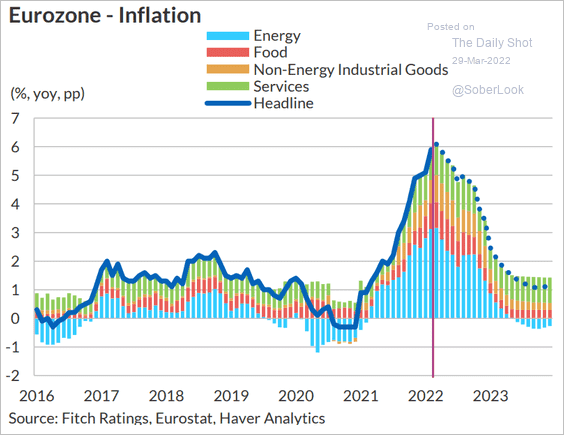
Courtesy Fitch Ratings
Regardless of the reason, it is definitely happening, and it isn’t “transitory” as the former head of the Federal Reserve claimed that it would be. If the so-called experts had been right, well inflation would be slowing.
Guess what, it isn’t slowing.
For those believers of free market principles, “the market” is now pricing in more aggressive rate hikes than previously anticipated, which threatens to usher in a new golden age of corporate restructuring.
In other words, corporations will get larger, much larger, which also means they will become even more politically influential than they are now.
Why?
Simply put, when prices increase, fixed costs and transaction costs increase. The only generally accepted ways to control this is by applying economies of scale, which means that firms buy and produce as much as possible in order to be as efficient as possible, and by eliminating transaction costs, which means that organizations go on acquisition sprees.
Basically, companies find ways to make a lot more of the same thing and to control more of the overall process of producing and getting it to customers. The result is that people who control those companies get a lot richer and more powerful, while the average worker becomes increasingly expendable and irrelevant.
In other words, inflation is good for the corporatists who own the American economy and both political parties, so expect it to continue for a while.
Allow me to explain.
Shadow Managers
The people who probably stand to gain the most from this trend are those consultants who will be hired as experts in mergers and acquisitions, aka M&A. While they were largely responsible for the heroin epidemic in the USA, McKinsey & Co., which is arguably the most prestigious management consultant agency in the world, will profit tremendously as firms are compelled by toxic investor culture to hire them.
McKinsey, and firms just like them, will tell everyone the same thing: Purchase as much of your supply chain as possible, because it reduces transactions costs, and it is your competitor’s supply chain as well, so you get leverage.
This trend has started already, but now it will become popular. The ensuing bidding war will drive up the firm valuation of companies previously thought to be ordinary, and the result of that will be more capital generation via the issuance of new stock into an inflated market.
If I’m losing you, don’t worry, it’s really very simple.
Companies, you know businesses that make and sell stuff to consumers, will end up with a lot more cash and assets, while everyone else will get royally fucked. The royal treatment comes because it’s the average worker who will bankroll this M&A frenzy via their 401k’s, increased taxes, and routine government bailouts of the private sector that are sold to the public as being necessary to sustain job-producing economic activity.
That’s the message they’ll give at least. Politicians on both sides of the now fictitious political aisle will scream at each other over issues that pit Americans against each other, meanwhile, they will near-unanimously vote to pass legislation that makes it easier for large corporations to steal more money from the public.
In the end, the money will be in the control of corporations, and everyone else will be living off of their corporate allowance.
This brings us to the one thing that America actually does that greatly impacts the global economy.
Money Supply
The supply of U.S. dollars, or as Americans call it, “money,” is highly important to the global financial system since it is the world’s top reserve currency. That means that during the exchange of any asset, the USD can serve as either a short-term or long-term transition tool.
This is because everyone trusts the dollar.
One of the reasons that the USD enjoys being the primary reserve currency in the world is that it has been historically stable. This makes sense.
The other reason is a bit more sinister.
The U.S. has it set up so that they can generate as much money as they want, and the only thing that the money needs is for the U.S. government to guarantee it. The catch is that every time the government issues new money, they are usually supposed to buy back old debt.
For the past two years, that debt has been at a near-zero interest rate.
Yeah.
In other words, if you were fortunate to give the gov a loan a decade ago, then your outstanding bonds are worth a lot today, because everyone wants to buy them. Why? Because bonds that yield into the future are rare.
On the other hand, if the Fed wants to repurchase old debt, then it’s going to get really expensive, which is probably why they finally decided to stop.
About those rate hikes
The global bond markets have suffered as a result of both the Fed and Europe saying that they will increase rates. How much have they suffered? Well, they’ve suffered trillions.
Yes, trillions of dollars have literally disappeared from the global economy.
High-yield funds have experienced nearly three full months of outflows, which is bad. New high yield issuance, meanwhile, is at a pace of about one-third that of 2021 — also bad. The pace of M&A has slowed, which isn’t necessarily bad, but it is when it precedes a recession and at the same time that banks are getting hung with underwritten debt.
So what happens now?
As interest rates collapsed during the pandemic, the price of stocks and other securities with long-term pay-offs have soared, meaning that most people can no longer afford them. If you wanted stability and security, well, sorry, it’s a seller’s market right now, so put your name on the list and maybe we’ll give you a call.
But don’t stay up waiting for it.
There’s more.
Shares of attractive technology firms like Zoom and Netflix, which were already sent higher by the Covid-19 pandemic, increased even more as the return on bonds all but vanished.
Lately, however, long-term interest rates have surged in anticipation of monetary tightening, causing these stocks to plummet. The turnaround has been dramatic for the most speculative stocks and wacko instruments such as cryptocurrencies.
In other words, Central Banks are trying to end the party of free money, and it’s costing those who tried to get rich quick. Professionals are now saying a recession is coming, which means that a recession is coming.
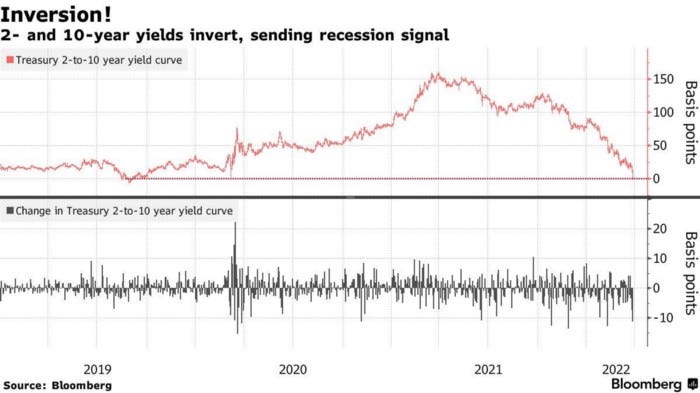
Courtesy Bloomberg
This chart shows an inverted yield curve, which means that there is an unusual drop of yields on longer-term debt below that of yields on short-term debt of the same credit quality. Also called a negative yield curve, the inverted curve has proven in the past to be a reliable indicator of a recession to come.
Many interested firms on Wall Street are saying that it doesn’t matter, and they are issuing press releases trying to calm the investment community. One guy named Jeffery Gundlach disagrees, and says they are lying.
Who is Jeffery Gundlach? A guy that dropped out of the PhD program in math at Yale because it wasn’t challenging enough, and a guy that has literally been called “The King Of Bonds.”
But no, Wall Street says, “don’t believe this guy, he’s just paranoid.”
And by the way, who the hell am I? Well, I’m not Jeffery Gundlach, but I do have an advanced degree in business, and another degree in how businesses bullshit the public. I also teach university-level business students (many of whom have lived under dictatorships) how the western financial system works.
There’s more, but who cares.
For what it’s worth, I agree with Jeff.
What about the Russia/Ukraine factor?
Geopolitical risk is hotter than ever with Russia’s invasion of Ukraine, exacerbating pre-existing energy, refugee, and supply chain crises all across Europe. The sanctions against Russia have restricted their ability to conduct energy trade as usual, and many Russian banks and companies have been turned off the global SWIFT payment system.
Foreign currencies like the USD and EUR have been restricted from exchanging with Russia, or with their currency, and energy imports have been almost fully restricted. In America, entirely so.
Putin tried to force Western Europe to pay for gas in Rubles, an effort to prop up his severely depreciated national currency. While it was thought that it might work because of the boomerang effect it would create for European sanctions against Russia, this type of short-term massive conversion wouldn’t even have worked before the war, and so the result is actually just creating energy prices to potentially increase until at least the latter half of this decade.
Members of the G-7 outright rejected Russia’s demands saying that is a breach of the pre-agreed contracts, however, the Kremlin said that Europe broke those contracts when they applied sanctions.
The current negotiations have come to a complete halt, and Putin is expecting Russia’s Central Bank and its energy giant, Gazprom, to come up with fresh ideas by March 31st.
I have a feeling they won’t have any.
Meanwhile, President Biden called Saudi Arabia to try and find some relief in the energy market. They actually didn’t return his calls, but they did say “trust us.”
Yeah… okay, we’ll trust the Saudis.
China and India are trying to remain neutral, while in the background buying up tanker loads of cheap Russian oil for a rainy day.
And what of OPEC? Well according to Reuters:
Saudi Arabia and the United Arab Emirates said the U.S. must trust OPEC+’s strategy, as Washington and other major importers call on the group to hike oil production following Russia’s invasion of Ukraine.
Crude prices surged to almost $140 a barrel soon after Moscow’s attack last month, though they’ve eased to around $110 this week amid a rise in coronavirus cases and tighter lockdowns in China. They’re still up by 40% this year.
OPEC+, led by Saudi Arabia and Russia, meets on Thursday to decide on output levels for May. Members have far signaled they see no need to divert from their policy of small increases each month.
We know that the USA, Japan, and Europe are pushing hard for production increases to drive prices down, but I have a feeling OPEC far prefers earning hundreds of billions in extra revenue, and that might be the only thing that keeps Russia from defaulting on its debt.
So what happens anyway if Russia defaults? Well, it’s not clear, because so much of what would have happened already has happened in the form of sanctions. A Russian default really just puts the nail in the coffin, but it also removes any remaining reasons for Russia to work with anyone else.
Do I need to tell you why it’s bad for an aggressive country with a massive military and nuclear arsenal to have no reason to play nice?
And oh yeah… Covid.
Pandemic-sparked supply chain issues continue to grow amid the ongoing waves of COVID-19 in supply hubs in China. The largest lockdown in China since Wuhan in early 2020 just occurred in Shanghai, the largest city in China. This has the potential to impact China’s oil demand, significantly.
In other words, one of the largest cities in the world that has a population close to that of Texas just locked down, Chinese style. In response, the already flipped out oil markets, well… they flipped out again.
China’s financial hub of Shanghai will lock down the city of 26 million in two stages to carry out #COVID19 testing over 9-days. It will enter lockdown, do PCR tests on everyone, stop all transit, close all factories, and all companies will work remote if possible.
Yeah.
What about food?
Everyone knows that Russia exports oil and rare earth minerals, but few realize that it is a leading producer of piss. Yes, urine. Specifically, the type used in fertilizer.
That’s right, fertilizer, the kind that helps grow food.
According to Bloomberg:
The war is pushing up the cost of natural gas, the main input for most nitrogen fertilizer, forcing some producers in Europe to cut output. Markets also worry that potential sanctions on Russia, a big low-cost shipper of every major kind of crop nutrient, could disrupt global trade. The country accounted for almost a fifth of 2021 fertilizer exports, according to Trade Data Monitor and Bloomberg’s Green Markets
There’s no sugar-coating this. This is directly from Bloomberg. If you don’t realize what that means, go and Google “Bloomberg.”
The Russian invasion of Ukraine threatens global agricultural production and may spawn food crises in various parts of the world.
That’s right, we could be at the onset of a global famine of historic proportions, and yet, in staggering defiance of logic, many U.S. politicians are still blaming price-taking producers of global commodities for gouging, and threatening producers of energy with windfall profits taxes. Meanwhile, they are resisting calls to remove bureaucratic hurdles to new production and are refusing the most basic laws of physics for, well, physics.
This is all blue, because these agenda items are never GOP, and so now they look like the only sane voice in the room.
Imagine that.
What it all means
Other than a few tech companies who are getting crushed, most corporations are reporting record earnings. If that doesn’t make sense, it’s because it doesn’t make any fucking sense.
Everyone from Ukrainian diplomats, to Putin, to Joe Biden are surprised by this. Jefferey Gundlach thinks we’re about to crash in ways never before seen.
What’s important to remember is that the market is driven by either confidence or fear. Today, we are in deeply uncharted territories that defy almost all of the traditional measures for gauging whether a market was strong, or about to tank.
The number one thing that people are afraid of is the unknown.
The financial industry PR machine might be able to fool people into staying calm for a short time, but soon enough panic will occur, and that will be the panic that finally brings down this historically and insanely high economy.
By nearly every single historical method for understanding the health of the economy, we should already be dead, put on display, and pushing up daisies. Why we aren’t is a matter of debate, one that has a lot of people pontificating, while some others are being opportunistic.
While all of those people are busy trying to position themselves as experts and gurus, the cause of the actual tremor that has caused this rampant inflation is still out there.
Prices on everything are going up, and will continue to climb until people can’t afford to pay their rent, drive to work, or feed their families. Those benefiting from it in the short-term will try to keep the train going, right up until it goes off of a cliff with them, and all us other passengers inside. If you think the unprecedented isn’t possible, you haven’t been paying attention to the past decade.
What happens next is an earthquake.
The big one.
Post a Comment