Crypto Scams and Scandals- The 10 Most Savagest Crypto Scams (And How To Avoid Them)
The 10 Most Savagest Crypto Scams (And How To Avoid Them)
Nobody is safe from #4 on the list.
Crypto is the wild wild west — there’s no beginner manual for newcomers. It’s like gaming online for the first time against players levels ahead of you — you’re bound to come across level 100+ guys who will beat you with ease.
In this case, take your crypto.
Scammers have their traps set out 24/7 (actually 25/8), and are ready to devour virgin crypto wallets containing anything from $3 to $1,000,000+.
To avoid any trap, you must first know how it looks and works.
Crypto is the digital land of opportunities — it’s important to know how scams differ from amazing opportunities because they can look the same.
So, here’s a 2021 list of crypto scams and Wing Chun techniques to avoid them for good:
1. Giving Someone Crypto So They Can Multiply It
Crypto newcomers aren’t inherently wrong for believing someone can multiply their money. In the business world, money goes to those who multiply it:
- Paying good marketers results in more products/services sold.
- Hiring business developers increases the chances of landing good deals.
- Buying ads will get your brand seen more, leading to more sales.
But the difference is, someone claiming to double your money should be able to do it for themselves, whereas business services must serve businesses to make money.
Why the hell would a random person double or triple your money for nothing in return? You must ask yourself these questions:
- How are they multiplying it?
- Can they show proof of how they double it?
- Why can’t they just do it for themselves?
- What’s in it for them?
If someone could double their own Bitcoin to infinity, they have no reason to approach you first. Anyone coming to you with this proposition is a red flag.
Solution: Avoid them at all costs.
2. Investing In “Passive Platforms”
These are platforms claiming to trade your funds so you receive a percentage every week. Most of these platforms claim to be trading, mining, or staking.
95% of the time, they’re Ponzi schemes — new money coming in to pay the old investors. Eventually, the scheme collapses when new money no longer arrives. The majority that joins in late and the investor with the largest capital will be getting burnt.
The reason why passive platforms continue to pop up: There’s proof that they’re paying. This half-truth is the lifeblood of passive platforms. It’s enough to convince you to join them.
How to tell if a passive income platform isn’t a Ponzi scheme:
A few platforms have been around for years and are still going despite the negativity they receive. Here are what they have in common:
Real Faces — If the owner of the platform isn’t willing to show their face, it’s a sign they don’t want their identity to be exposed when scamming you.
Strong Collaborations — When a platform has ties to a credible company or person, joining feels safer as their credibility is on the line.
Proof of Income — Platforms showing any form of receipts make their claims more believable. But, it doesn’t truly prove that their source of income is real as the proof can be fake.
Refunds — Ponzi schemes can’t function if refunds are involved. If old investors aren’t getting their payments disrupted when a new investor makes a refund, it confirms the possibilities of different sources of income.
3. Signing Up to Exchanges That Offer Free Crypto
Here’s how to tell quickly if it’s a scam or not:
- Legit Exchanges — It would be under some condition such as you depositing $500, referring multiple members, or withdrawal restrictions.
- Non-Legit Exchanges — No conditions, just free crypto for joining.
No crypto exchange gives money away for free. If it were true, everyone would milk it by joining and withdrawing the funds. Some would go as far as to create multiple accounts. Exchanges would never profit.
If an exchange isn’t decentralized, the owners owe it to you for their faces to be revealed in the form of videos, LinkedIn profiles, interviews, and press releases. It decreases the chances of a rug pull or “hack” where an anonymous person (founder) steals millions of crypto.
Most identified owners wouldn’t exit scam, and they’d make sure their exchange is well protected to prevent hacks. They know everything falls back on them.
Solution: Stick to credible exchanges that have good volume.
4. Well-Timed Crypto Email Scams
Okay, these are one of the most vicious scams out there because top business professionals even fall for them. It’s when scammers pretend to be big companies and do any of these acts:
- Send you a link to buy crypto on a site you use, with the incentive of receiving free money.
- Claim your account has been compromised with a link to reset your password (so they can take it).
- Say you’ve won crypto on an exchange and provide a unique link to claim it.
- Send you well-written fake contracts of partnerships which include a crypto address for you to send funds.
- Promise you employment, but there’s a fee you must pay first.
- Pretend to be your colleague or superior in an email that involves a fraudulent link or an address for you to send money to (I almost fell for this years ago)
Here are quick ways to tell if these emails are scams: Dodgy/incorrect email addresses, bad spelling, and incorrect URL links.
But, these quick scam detection methods can easily be overridden by intelligent phishing emails that include either:
Intense Fear & Urgency — When you’re told your account is hacked and someone is attempting to make money right now, you’re put in a state of fear and will do anything to get out of it. This can make you bypass double-checking the email to know it’s legit.
Justified Greed — This is another emotion why humans fall into dumb or sophisticated scams. We all have our desires and scams promising crypto will only stimulate them.
To avoid these scams:
- Contact companies on their website to verify the email you’ve just received.
- Copy the URL address of links and paste it somewhere to see if the domain is correct (if pasting on a web address bar, DON’T CLICK ENTER).
- Check the reply-to email address — scammers can spoof by sending emails with a legit “from address”. Reply-to addresses are sometimes different.
- For the love of Satoshi Nakamoto, don’t send anyone your private keys.
5. Tricked By Fake Crypto Instagram Accounts
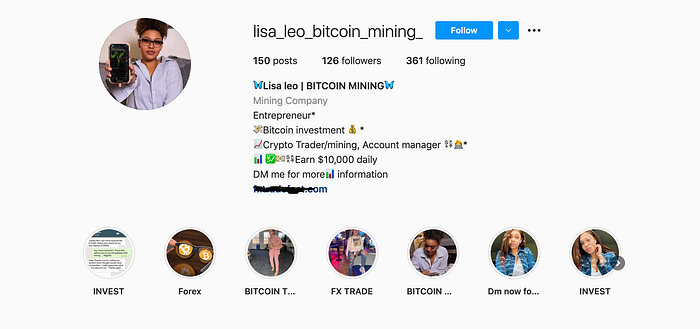
Someone with 100 followers telling you they can make you $10,000 a day, but you have to send them Bitcoin first is 100% planning to scam you.
Or if they have 50k followers, chances are it’s 40 likes a post — don’t trust these people too.
Sometimes these fake accounts might be referring you to an MLM or Ponzi scheme, so they might have proof of results from others. But let’s be real, if they were making good money from it, they wouldn’t need you. By the time you get in, it’s a wrap.
Many of these Insta accounts falsely appear as women to lure you in.
Solution: Block or ignore them.
6. Deceived By Crypto Influencers (Imposters)
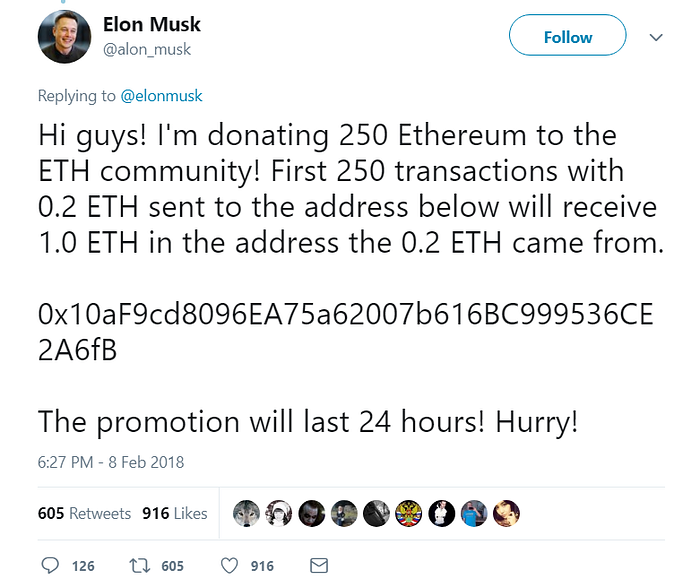
Some scammers like to disguise themselves as real influencers so they can take your crypto. They may use smart promotion tactics like FOMO as shown in the image above.
Many crypto influencers sell products and services, so scammers use that as the reason to DM you, and get you to send them money.
Solution: Never trust an influencer (or anyone) that messages you first. Also, make sure you double-check usernames before taking action.
7. Comment Hijacking With Validation
Crypto YouTube videos are bound to receive a comment about someone who helped them make Bitcoin — either a website or a person. Comments like these tend to have 100+ likes and positive replies making it seem real. These comments can also be a personalized reply to your comment.
Review sites can contain these comments for services that are crypto-related.
Solution: Don’t trust any of them, especially when they tell you to contact them through WhatsApp.
8. Buying Fake Crypto Coin Projects
Meme coins…
Many people missed the dogecoin wave so it’s natural for them to look for the next thing that will moon. Scammers know this. They’ll create a coin based on an animal or something stupid, and then put the coin on UniSwap. But that’s not the part where people fall for these scam coins — it’s the website.
Scam coins have well-designed sites with long roadmaps suggesting that it’s a real serious project, with real people behind it.
These projects are usually pump-and-dump coins.
Also, don’t fall for the YouTube videos of these coins — the YouTubers themselves might not know it’s a scam yet (or they might be in on it).
Here’s how to tell if a coin project is a scam:
- No visible founder: Straight red flag. Especially there’s a single or a few wallets holding most of the supply.
- No use cases: If the coin doesn’t serve a purpose, then its purpose is to take your Bitcoin and give it to the anonymous founders.
- No progress: Projects that aren’t accountable to their roadmap likely mean there’s nobody making things happen.
9. Installing Fake Crypto Wallet and Exchange Apps
Scammers are making fake versions of real apps and deploying them onto the iOS and Google Play store. Downloading and using them puts your account passwords, private keys, and crypto you hold at risk.
Someone lost $600,000 worth of Bitcoin in a second by downloading a fake Trezor wallet app.
Solution: Always click the app store download links from the official website of that app. Don’t even trust ratings and reviews you see on app stores.
10. Getting Upsell Scammed
To be scammed is one thing, but to get scammed again in hopes of recovering the funds you were scammed for is brutal. Anyone telling you to give them Bitcoin to recover the Bitcoin they just stole from you is a heartless scammer.
Solution: If they pretend to be a crypto company, go to the company website and contact them there so you can report what happened.
Crypto is one hell of a drug.
Stay safe. If you’re ever convinced the person messaging you is legit, despite after seeing the list of scams above, there’s one sure way to tell:
Ask Them To Exchange Cryptocurrency Through An Escrow Site
This is when you protect a transaction by giving funds to a 3rd party. The funds are released to the receiver when conditions (you both agree on) are met.
Scammers will avoid this at all costs.
Escaroo is a high-quality escrow site for crypto transactions. They cater to individuals and businesses, plus they have a marketplace for you to create offers.
Protect your crypto at all times.
Also, protect yourself from crypto YouTubers:
Post a Comment